The Belfast Buoys
The Belfast Buoys, located at Abercorn Basin Marina, are striking maritime landmarks that celebrate the city’s rich nautical heritage. Recently restored and relocated to the Maritime Mile in 2019, these distinctive navigation buoys once played a vital role in guiding vessels safely to and from Belfast Port. Each buoy weighs approximately three tonnes and is constructed from thick steel plates riveted together. Estimated to be around 80 years old, the buoys would have been essential aids for mariners, marking safe channels through the harbour’s busy waters. Today, they stand as powerful reminders of Belfast’s working waterfront and its enduring connection to shipbuilding, trade and seafaring life.
Big Fish
This 10m (32ft) salmon was commissioned in 1999 to celebrate the regeneration of the River Lagan and the historic importance of the site. If you're visiting the Lagan Lookout, or admiring the Customs House, you'll notice a big fish sculpture beside the Lagan. It was created by John Kindness, and the most interesting thing about this fish are its beautiful blue scales, which are made up of ceramic tiles describing different scenes from the city's history.
SoundYard
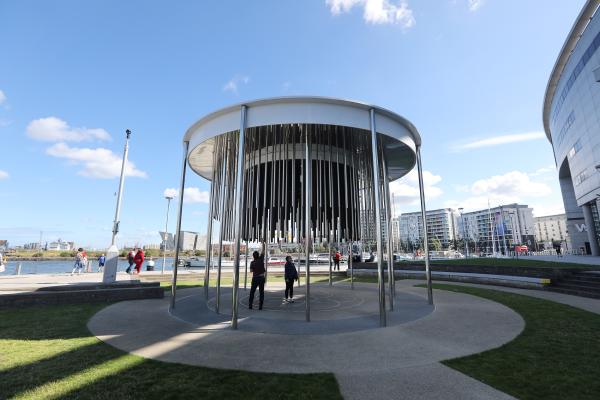
SoundYard is a playful, interactive art installation on Queen’s Quay near the Odyssey and Abercorn Marina, inspired by the sounds and energy of Belfast’s historic shipyards. Created as the winning entry in the City Play Design Competition by RSUA, JP Corry and Maritime Belfast, it celebrates the city’s maritime heritage through a striking 6-metre-high structure of suspended metal rods and sound tubes that visitors can activate to recreate the rhythmic sounds of hammering and riveting once heard across the docks. The installation draws on Belfast’s industrial past while embracing innovation, sustainability and re-use, and transforms after dark into a glowing light sculpture along the waterfront.
Harland and Wolff Cranes
The two great yellow-painted gantry cranes Samson and Goliath have become icons of Belfast, dominating the entire city skyline. Constructed to service the vast new graving dock at Harland and Wolff, Goliath (the smaller at 315 ft) began work in 1969, and the 348ft Samson five years later. Each of the Krupp-Ardelt designed cranes can lift loads of up to 840 tons. Harland and Wolff were still one of the world's great shipbuilders at the time and the building of the two cranes, during a difficult period for shipbuilding in Belfast, was seen as a sign of faith in the future.
The Great Light
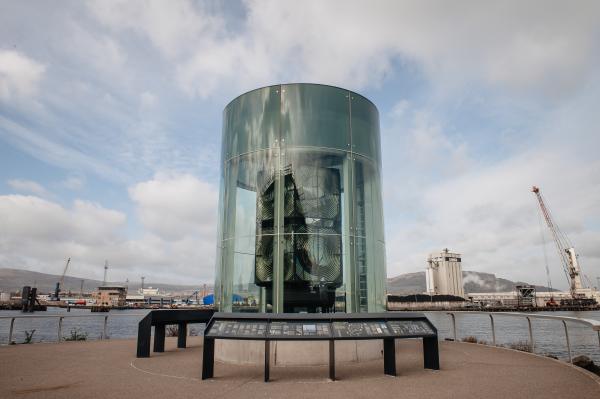
Located on the Titanic Walkway, the Great Light is one of the largest lighthouse optics of its kind ever built. The optic is around 130 years old, weighs 10 tonnes and measures 7 metres tall. The Great Light served two lighthouses in its time, Tory Island off the coast of Donegal, and Mew Island off the Co. Down coast. The optic would have once produced one of the strongest lighthouse beams, ideal for landfall lighthouses. The Mew Island lighthouse was requested by the Belfast Harbour Commission as an important Aid to Navigation at the southern entrance to Belfast Lough, built at a time when Belfast was the world-centre of linen, shipbuilding and ropemaking, and one of the most important ports in the world.