Donegall Quay
One of Belfast’s earliest remaining quays, Donegall Quay was built in the early 1800s and named after the Earls of Donegall, one of Belfast’s original landowning families, also commemorated by Donegall Square, surrounding City Hall.
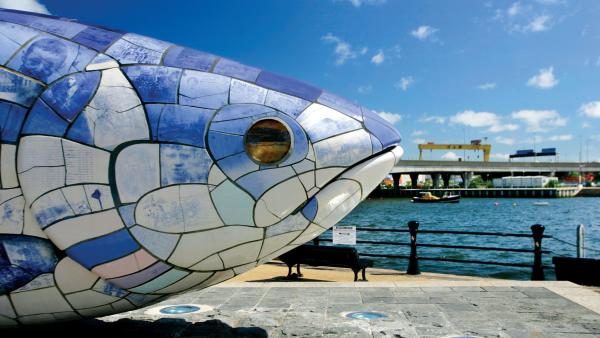
A walk along Donegall Quay offers some of the best views of Belfast – you can see out towards Belfast Lough and upriver to the city centre. City Quays also includes the park around the Big Fish sculpture, Belfast’s salmon of knowledge, which is the starting point for the Maritime Mile. Keep an eye out for the Sammy the Seal sculptures, marking the seal colony that still lives in Belfast Harbour.
City Quays
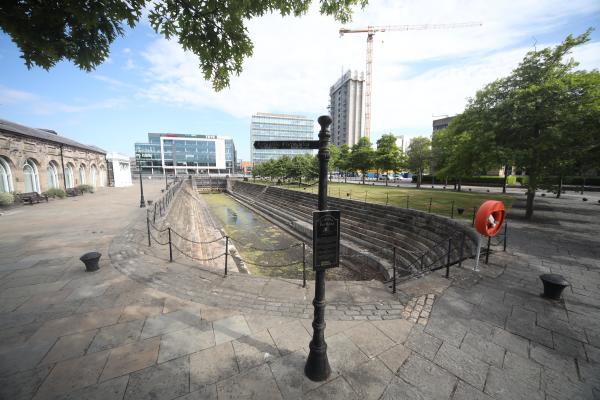
Belfast Harbour was first established in the area now known as City Quays, where the rivers Lagan, Farset and Blackstaff converged. The first quays were built here for early merchants trading linen and other commodities. Modern Belfast retains much of its early maritime heritage, and the area once dominated by shipyards is now one of Europe’s largest waterfront regeneration sites with millions of visitors every year, and a busy port handling millions of tonnes of cargo.
The area is currently being regenerated from old shipping warehouses and port operations into modern office blocks and hotels.
Queens Quay
Queen’s Quay was once a vital part of Belfast’s history when the Belfast and County Down Railway Station was established there in 1848. Today, it remains an important gateway, welcoming over 3 million visitors who walk, cycle, wheel and visit the Maritime Mile every year.
Clarendon Dock
The oldest remaining docks in Belfast Harbour are the Clarendon dry docks, built in the 1800s, by Belfast’s first commercial shipbuilder, William Ritchie. He originally set his shipyard up at the Old Lime Kiln Dock (where Corporation St is now) but Ritchie needed a dry dock, so Belfast Harbour agreed to build a dock which Ritchie built himself, completing it in 1800. Known as Ritchie’s Dock for years, it was later renamed Clarendon Dock No 1. The second Clarendon Dock was completed in 1826. The Victorian dry docks are no longer used but remain an important link to Belfast’s maritime past.
Hamilton Dock
The Hamilton Dock is the oldest graving dock on the Co. Down side of the River Lagan, built between 1864 and 1867. A graving dock is a nautical term for an enclosed basin into which a ship can be taken for underwater cleaning or repair. The Hamilton Dock is now listed as a historic scheduled monument, and for more than 120 years it was used for repairing, maintaining and fitting out ships. The Hamilton Dock is now home to the SS Nomadic and the Caisson Gate. The Caisson Gate is the original Hamilton Dock gate and sits at the other end of the Hamilton Dock to the SS Nomadic. Built in 1867, the Caisson gate is one of the oldest remaining Harland & Wolff constructions, and is actually a vessel, given the hull number 50 in H&W’s shipping register. A hollow vessel built from wood and steel, the Caisson was a watertight entrance gate that allowed the dock to be emptied.
Alexandra Dock
At the furthest point of the Maritime Mile, is the Alexandra Dock. As Harland & Wolff began to design larger ships, they needed larger docks to house them. The Alexandra Dock was built between 1885-89, just over 800 feet long and 80 feet wide, and was the largest dry dock in the world at the time. It was also designed to be separated into 3 sections, using caissons to have a combination of dry and flooded dock space. The caissons for the dock were built by another local shipbuilder, Workman Clark, and given the yard numbers 53 and 54. The Dock was named for the Princess of Wales, Princess Alexandra, who cut the first sod. The Alexandra Dock is now permanently flooded and home to HMS Caroline.
Thompson Dock
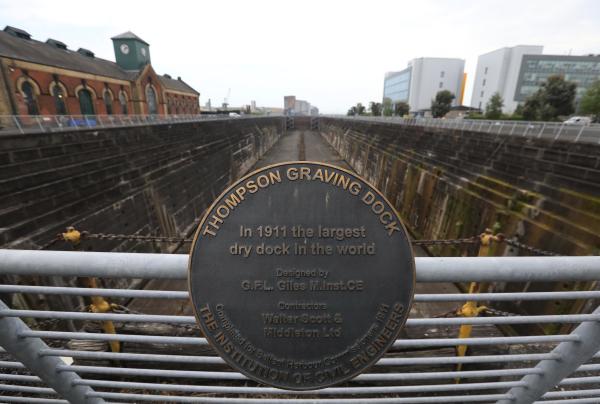
The huge dry dock was built specifically to house the Olympic Class liners that Harland & Wolff had designed. It was completed in 1911 and named after the chairman of the Belfast Harbour Commission, Robert Thompson. RMS Olympic was the first ship to glide into the Thompson Dock. The Olympic class liners just fitted the Dock, which is 850 foot long and 100 foot wide. The dock was used until 2002; some restoration work was carried out in 2010 allowed it to be opened and now you can descend 67 steps into the historic location where Titanic last rested on dry land with a tour at Titanic Distillers.
Slipways
The Titanic and Olympic slipways were developed especially for the Olympic class liners, Titanic, Olympic and Britanic. Made of reinforced concrete at an angle down towards the sea, the slipways are over 4ft thick in places with a framework of steel. A huge steel Arrol gantry once stood over the slipways to assist with the construction of the ever-bigger H&W ships. The slipways are now scheduled monuments and were restored as part of the development of Titanic Belfast. The Titanic slipway contains the outline of the deck of the Titanic, including the locations of the benches on board, and the Olympic slipway is a Titanic memorial garden, with decked and grassed areas representing the numbers of survivors and victims of the Titanic tragedy.