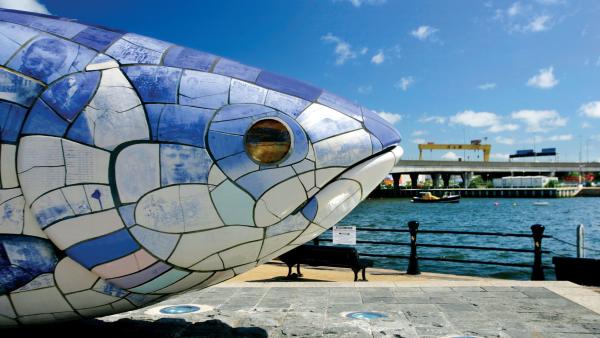
The Salmon of Knowledge
Donegall Quay, Belfast City Centre
John Kindness, 1999
Affectionately known as the Big Fish, this 10-metre long salmon was created by one of Northern Ireland’s best known artists, John Kindness and has become iconic in Belfast. Situated in front of the Charles Lanyon designed Victorian Custom House, the fish is covered in printed ceramic tiles decorated with text and images relating to the history of Belfast, and also contains a time capsule storing information, images and poetry on the city.
Beacon of Hope
Thanksgiving Square, Belfast City Centre
Andy Scott, 2006
The Thanksgiving Statue is a metal sculpture by Andy Scott, rising 19.5 metres high over the banks of the River Lagan. Characteristic of Belfast, the structure has picked up several nicknames including ‘Nuala with the Hula’, the ‘Doll on the Ball’ and the ‘Thing with the Ring’. It is currently the second largest public art sculpture in Belfast, after Rise on Broadway Roundabout, and is based on Thanksgiving Square in Dallas, Texas.

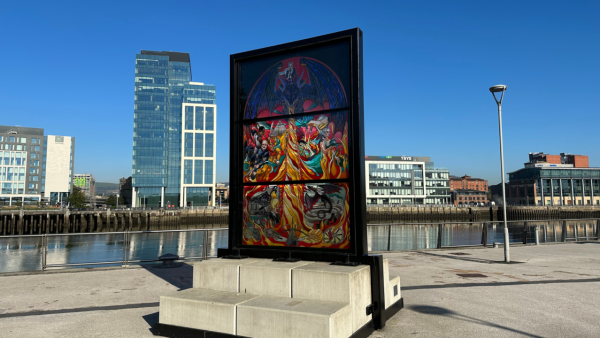
Glass of Thrones
To celebrate 10 years of filming in Northern Ireland, Tourism Ireland created six giant, stained glass windows depicting some of the most iconic scenes from Game of Thrones. Each window represents a different house or legacy from the show including the Starks, Lannisters, Baratheons, Targaryens, White Walkers and the Iron Throne.
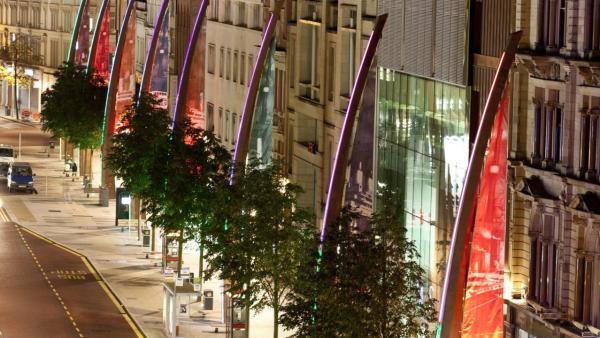
The Masts
Donegall Place, Belfast City Centre
As part of the Belfast: Streets Ahead public realm improvement project, these eight feature lighting masts were installed on Donegall Place in 2010 and 2011. Designed to create a historical context to the area, Belfast’s industrial heritage, linen industry and maritime traditions are all reflected in the masts, which are clad in copper and over 16 metres high.
Each mast commemorates one of the great White Star Line ships built in Belfast by Harland and Wolff. Names of the vessels, in order of their position from Belfast City Hall, are Titanic, Olympic, Oceanic, Britannic, Laurentic, Celtic, Nomadic and Traffic.
The Searcher
Upper Newtownards Road, east Belfast
Ross Wilson, 1998
Unveiled on the centenary of CS Lewis birth, The Searcher sculpture by Northern Irish artist Ross Wilson is based on Digory Kirke, one of the characters from the Narnia story, The Magician’s Nephew. Through this magical wardrobe the Pevensie children, Peter, Susan, Edmund and Lucy, enter Narnia and meet the talking animals and mythological creatures that populate that snowbound world.
The Searcher is modelled on Belfast-born CS Lewis as he was in 1919, and in the words of the artist, the sculpture tries to capture the great ideas of sacrifice, redemption, victory, and freedom for the sons of Adam and the daughters of Eve that lie at the heart of the Chronicles of Narnia.

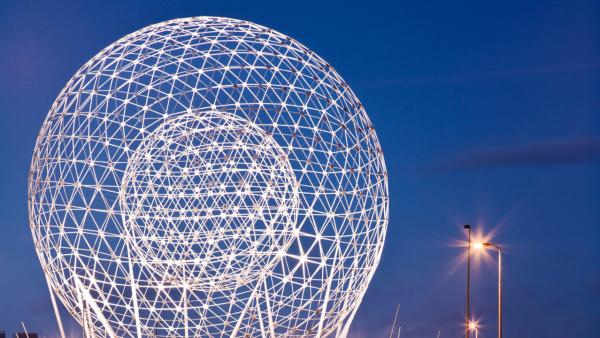
RISE
Broadway Roundabout, Westlink
Wolfgang Buttress, 2011
This is the biggest piece of public art sculpture in Belfast, and unmissable on the M1 motorway, gateway to the city. The sculpture’s two globes, cast in white steel, symbolise the rising of the sun and new hope for Belfast’s future. At over 37 metres high and 30 metres in diameter, RISE is visable for miles around the city.
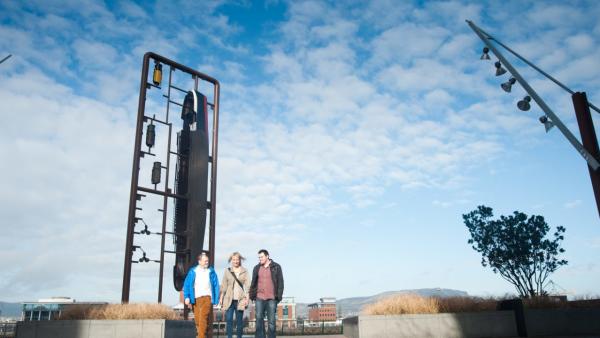
Kit
Titanic Quarter
Tony Stallard, 2009
Kit, in the Titanic Quarter, is a dramatic sculpture cast in bronze. The air fix style artwork depicts recognisable elements of the Titanic on an outer frame. The giant modelling kit uses scale replicas of the famous ship’s component parts and recreates the legendary liner beside the Abercorn Basin, near where the real ship was built.
The Yardmen
Dr Pitt Memorial Park, Newtownards Road, east Belfast
Ross Wilson, 2012
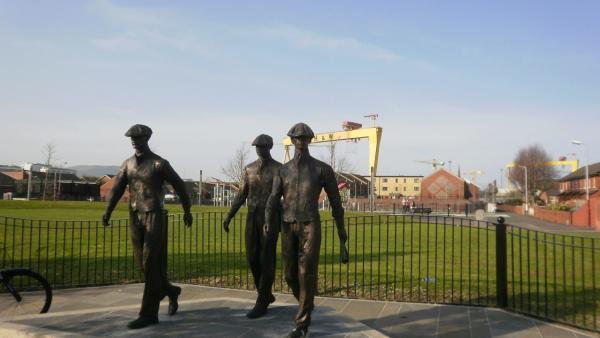
East Belfast was an industrial powerhouse in the 19th and much of the 20th century. With over 30,000 men were employed at the Harland & Wolff shipyard, The Yardmen statue celebrates the east Belfast workers who built Titanic and many other great ships. Unveiled on 28 March 2012, just days before the centenary of Titanic leaving Belfast, the three Yardmen reflect the great pride the people of east Belfast have in their community and its world famous achievements.
The Seahorse
Dargan Road
Ralf Sander, 2013
The Seahorse sculpture was commissioned to record the 400th anniversary of the first quay to be granted and constructed in the city, on High Street in 1613. Reflecting Belfast’s maritime heritage, The Seahorse rests on an enlarged shipping bollard and stands at eight metres high. The sculpture has strong connections to Belfasts origins, with the citys first merchants printing seahorses on their coins throughout the 17th century, and the two seahorses which appear on the city’s coat of arms.

Monument to the Unknown Woman Worker
Europa Bus Station, Belfast City Centre
Louise Walsh, 1992
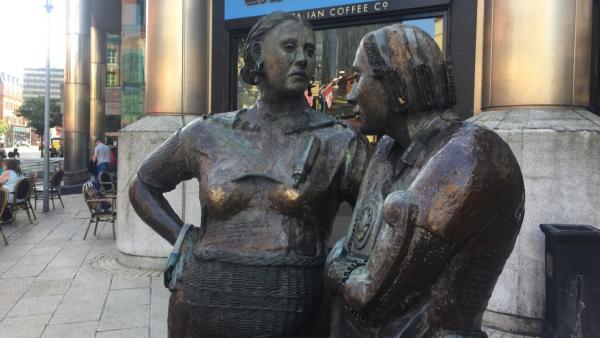
Built in 1992 by Louise Walsh in Belfast, the artist chose to focus on the women’s rights issues of low-paid jobs and unpaid housework. This artwork will be the first many visitors to the city will see as it is at the entrance to the Europa Bus Centre and Great Victoria Street Train Station.
Sammy the Seal
Donegall Quay, Belfast City Centre
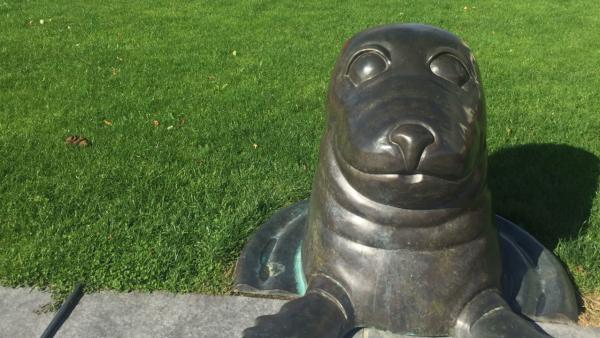
Regeneration of Donegall Quay has created a public space for locals and visitors to relax beside the River Lagan, where you’ll find Sammy the Seal. The nickname for the seals that frequent the estuary of Belfast Lough, discover three bronze seals that can be seen popping their heads above the paving stones, mimicking the real family of seals who have moved into the estuary.
The Speaker
Custom House Square, Belfast City Centre
Gareth Knowles, 2005
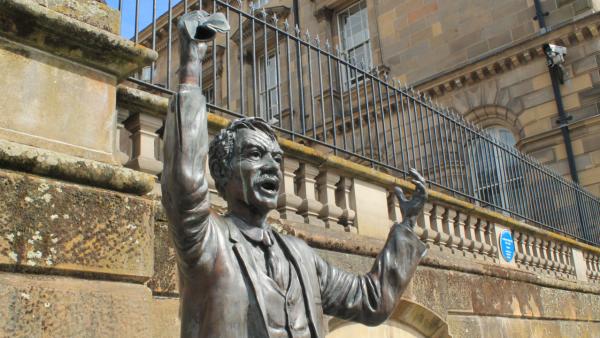
Custom House Square was an important area to trade in Belfast, causing the Custom House to be built 18541857. In the square you’ll see the Albert Clock, Calder Fountain and McHughs Bar, dating from the 17th century. The steps of the Custom House were used as a speakers corner during the 19th century, often with significant crowds gathering in the Square. The statue stands at the foot of the steps where public speakers and evangelists used to speak, and includes bronze footsteps on the ground in front, suggesting crowds of supporters, or hecklers.
Spirit of Belfast
Cornmarket, Belfast City Centre
Dan George, 2009
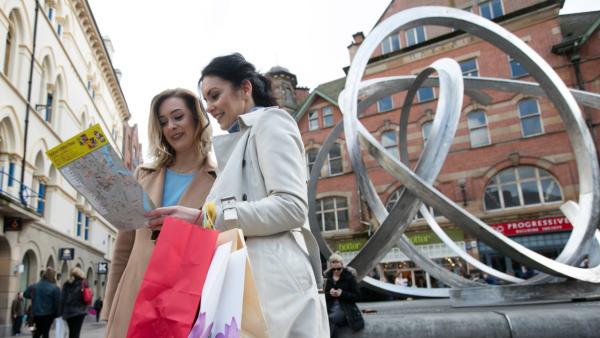
This large-scale steel structure looms where a bandstand once stood with four interlocking rings. Situated in the heart of the city centre’s pedestrianised shopping area, it was designed to reflect Belfast’s former shipbuilding and linen industries.